RUSSIE | iTW | Entretien imaginaire avec Léon Tolstoï {FICTION}
5 janvier 2026
0 Comments
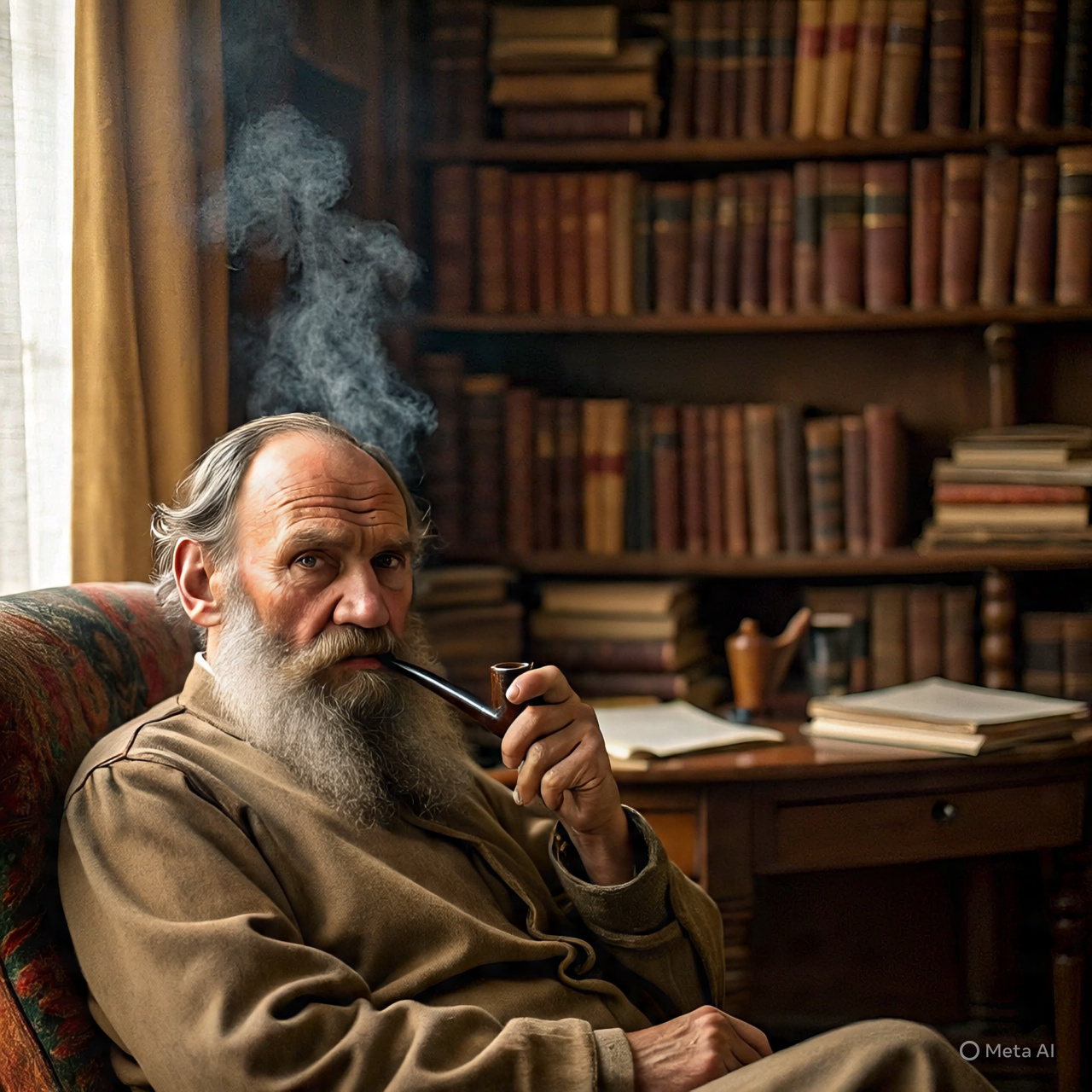
Il est des écrivains dont la vie se confond avec l’histoire de leur pays et dont l’œuvre devient un miroir de l’humanité tout entière. Léon Nikolaïevitch Tolstoï, né en 1828 à Iasnaïa Poliana, incarne cette figure rare.
Share This Article:
ВоображаемоеинтервьюсЛьвомТолстым)
(Introduction to the Imagined Interview with Leo Tolstoy / Введение к воображаемому интервью с Львом Толстым)
Version française
Aristocrate russe, officier dans le Caucase, témoin de la guerre de Crimée, puis prophète moral en quête de vérité, il a traversé le XIXᵉ siècle comme un géant, laissant derrière lui des fresques littéraires qui continuent de nourrir la conscience universelle !
On raconte que, jeune homme, il se passionnait autant pour les récits de Rousseau que pour les travaux agricoles de ses paysans. Ses carnets de jeunesse témoignent d’une obsession précoce pour la discipline morale et l’auto‑analyse, annonçant déjà l’écrivain qui, plus tard, interrogerait sans relâche la condition humaine. Ses années militaires lui inspirèrent Les Cosaques, où la beauté sauvage du Caucase se mêle à la vanité des combats. Puis vint l’œuvre‑monde, Guerre et Paix, écrite entre 1865 et 1869, fresque où Napoléon devient une ombre parmi des milliers de vies anonymes, et où l’histoire se révèle comme une force collective plutôt qu’un destin individuel.
Tolstoï ne fut pas seulement l’auteur de chefs‑d’œuvre romanesques. Il fut aussi un penseur radical, dénonçant l’hypocrisie de l’Église orthodoxe, prônant une vie simple et paysanne, et inspirant des figures comme Gandhi par ses écrits sur la non‑violence. Ses contradictions sont célèbres : aristocrate vivant dans un domaine somptueux, mais prônant l’ascétisme ; père de treize enfants, mais obsédé par l’idéal de chasteté ; écrivain adulé, mais en lutte contre la gloire littéraire. Ses œuvres tardives, telles que La Mort d’Ivan Ilitch ou La Sonate à Kreutzer, témoignent d’une quête d’épure et d’une méditation sur la mort, l’amour et la vérité intérieure.
Les anecdotes abondent : Tolstoï marchant pieds nus dans son domaine pour se rapprocher des paysans ; Tolstoï refusant les droits d’auteur de ses œuvres religieuses pour les offrir au peuple ; Tolstoï en fuite, à 82 ans, quittant sa maison en pleine nuit pour chercher une vérité ultime, avant de mourir dans une petite gare, Astapovo, en 1910. Sa mort elle‑même fut un symbole : le prophète qui s’éteint loin des salons, dans la simplicité d’un lieu de passage, comme pour rappeler que la vie est un voyage inachevé.
Cet entretien imaginaire s’inscrit dans cette tradition : interroger Tolstoï, c’est interroger la littérature, la philosophie, la politique, la religion et la conscience humaine. C’est convoquer un homme qui, par ses œuvres et ses contradictions, continue de nous parler au XXIᵉ siècle.
English version
There are writers whose lives merge with the history of their nation, and whose works become mirrors of humanity itself. Leo Nikolaevich Tolstoy, born in 1828 at Yasnaya Polyana, embodies this rare figure. A Russian aristocrat, an officer in the Caucasus, a witness to the Crimean War, and later a moral prophet in search of truth, he traversed the 19th century as a giant, leaving behind literary frescoes that continue to nourish universal conscience.
It is said that as a young man, he was as fascinated by Rousseau’s writings as by the agricultural work of his peasants. His early diaries reveal an obsession with moral discipline and self‑analysis, foreshadowing the writer who would later relentlessly question the human condition. His military years inspired The Cossacks, where the wild beauty of the Caucasus mingles with the vanity of combat. Then came the world‑work, War and Peace, written between 1865 and 1869, a fresco where Napoleon becomes a shadow among thousands of anonymous lives, and history reveals itself as a collective force rather than an individual destiny.
Tolstoy was not only the author of monumental novels. He was also a radical thinker, denouncing the hypocrisy of the Orthodox Church, advocating a simple peasant life, and inspiring figures such as Gandhi with his writings on non‑violence. His contradictions are legendary: an aristocrat living in a sumptuous estate yet preaching asceticism; father of thirteen children yet obsessed with the ideal of chastity; a celebrated writer yet at war with literary fame. His later works, such as The Death of Ivan Ilyich or The Kreutzer Sonata, testify to a quest for austerity and meditation on death, love, and inner truth.
Anecdotes abound: Tolstoy walking barefoot across his estate to draw closer to the peasants; Tolstoy refusing royalties on his religious works to give them to the people; Tolstoy fleeing at the age of 82, leaving his home at night in search of ultimate truth, before dying in a small railway station, Astapovo, in 1910. His death itself was symbolic: the prophet extinguished far from salons, in the simplicity of a place of passage, as if to remind us that life is an unfinished journey.
This imagined interview is part of that tradition: to question Tolstoy is to question literature, philosophy, politics, religion, and human conscience. It is to summon a man who, through his works and contradictions, continues to speak to us in the 21st century.
Русская версия
Есть писатели, чья жизнь сливается с историей их страны, а произведения становятся зеркалом всего человечества. Лев Николаевич Толстой, родившийся в 1828 году в Ясной Поляне, воплощает эту редкую фигуру. Русский аристократ, офицер на Кавказе, свидетель Крымской войны, а затем пророк морали в поисках истины, он прошёл через XIX век как гигант, оставив литературные полотна, питающие универсальную совесть.
Говорят, что в юности он увлекался сочинениями Руссо не меньше, чем крестьянским трудом своих подданных. Его ранние дневники свидетельствуют о навязчивом стремлении к нравственной дисциплине и самоанализу, предвещая писателя, который позже будет неустанно исследовать человеческое существование. Военные годы вдохновили Казаков, где дикая красота Кавказа переплетается с тщетностью боёв. Затем пришло произведение‑мир, Война и мир, написанное между 1865 и 1869 годами, полотно, где Наполеон становится тенью среди тысяч анонимных жизней, а история раскрывается как коллективная сила, а не индивидуальная судьба.
Толстой был не только автором монументальных романов. Он был радикальным мыслителем, разоблачавшим лицемерие православной церкви, пропагандировавшим простую крестьянскую жизнь и вдохновлявшим таких деятелей, как Ганди, своими трудами о ненасилии. Его противоречия легендарны: аристократ, живущий в роскошном имении, но проповедующий аскетизм; отец тринадцати детей, но одержимый идеалом целомудрия; прославленный писатель, но в борьбе с литературной славой. Его поздние произведения, такие как Смерть Ивана Ильича или Крейцерова соната, свидетельствуют о стремлении к строгости и размышлениям о смерти, любви и внутренней истине.
Анеcdоты многочисленны: Толстой, идущий босиком по имению, чтобы приблизиться к крестьянам; Толстой, отказывающийся от авторских прав на религиозные сочинения ради народа; Толстой, бегущий в 82 года, покидающий дом ночью в поисках последней истины, и умирающий на маленькой станции Астапово в 1910 году. Его смерть сама по себе стала символом: пророк угасает вдали от салонов, в простоте места перехода, словно напоминая, что жизнь — это незавершённое путешествие.
Это воображаемое интервью продолжает эту традицию: задавать вопросы Толстому — значит задавать вопросы литературе, философии, политике, религии и человеческой совести. Это значит призывать человека, который через свои произведения и противоречия продолжает говорить с нами в XXI веке.
🎙️ Réponses imaginaires de Léon Tolstoï
(Imagined Answers of Leo Tolstoy / ВоображаемыеответыЛьваТолстого)
I. La jeunesse et les origines / Youth and Origins / Юностьиистоки
Q1 : Quels souvenirs de votre enfance à Iasnaïa Poliana ont façonné votre sensibilité littéraire ?
FR : « À Iasnaïa Poliana, j’ai appris que la terre parle autant que les livres. Les champs, les paysans, leurs gestes quotidiens m’ont enseigné la vérité brute de l’existence. Ce contraste entre la noblesse de mon milieu et la simplicité du peuple a nourri mon désir de comprendre l’âme humaine. »
EN : “At Yasnaya Polyana, I learned that the land speaks as much as books. The peasants, their daily gestures, taught me the raw truth of existence. The contrast between my noble background and the simplicity of the people nourished my desire to understand the human soul.”
RU : « В Ясной Поляне я понял, что земля говорит не меньше, чем книги. Крестьяне, их ежедневные движения научили меня суровой правде существования. Контраст между моим дворянским происхождением и простотой народа питал моё стремление понять человеческую душу.»
Q2 : Comment vos années militaires dans le Caucase ont‑elles influencé vos premiers récits (Les Cosaques) ?
FR : « La guerre m’a montré la vanité des gloires et l’absurdité des violences. Dans Les Cosaques, j’ai voulu peindre non pas l’héroïsme, mais la contradiction d’un homme partagé entre la beauté du monde et la brutalité des armes. »
EN : “War revealed to me the vanity of glory and the absurdity of violence. In The Cossacks, I sought not to depict heroism, but the contradiction of a man torn between the beauty of the world and the brutality of weapons.”
RU : « Война показала мне тщету славы и абсурдность насилия. В Казаках я хотел изобразить не героизм, а противоречие человека, разрываемого между красотой мира и жестокостью оружия.»
II. Les grandes fresques / Monumental Frescoes / Монументальныеполотна
Q4 : Guerre et Paix est une fresque historique et philosophique. Quelle était votre ambition ?
FR : « Je n’ai pas écrit Guerre et Paix pour glorifier les batailles, mais pour montrer que l’histoire est faite par des forces invisibles, par la multitude des vies ordinaires. Les grands hommes ne sont que des ombres portées par le mouvement collectif. »
EN : “I did not write War and Peace to glorify battles, but to show that history is shaped by invisible forces, by the multitude of ordinary lives. Great men are but shadows cast by collective movement.”
RU : « Я писал Войну и мир не для прославления битв, а чтобы показать, что историю создают невидимые силы, множество обычных жизней. Великие люди — лишь тени, отбрасываемые коллективным движением.»
Q5 : Dans Anna Karénine, quelle vérité universelle cherchiez‑vous à révéler ?
FR : « Anna est le miroir des contradictions sociales et morales de son temps. En elle, j’ai voulu montrer que la passion, lorsqu’elle se heurte aux conventions, devient tragédie. Mais au‑delà, c’est la question de la liberté et de la vérité intérieure qui m’obsédait. »
EN : “Anna is the mirror of the social and moral contradictions of her time. In her, I sought to show that passion, when colliding with conventions, becomes tragedy. Beyond that, it was the question of freedom and inner truth that haunted me.”
RU : « Анна — зеркало социальных и моральных противоречий своего времени. В ней я хотел показать, что страсть, сталкиваясь с условностями, становится трагедией. Но за этим меня мучил вопрос свободы и внутренней правды.»
Q6 : Vos récits courts traduisent une évolution vers l’épure. Pourquoi ?
FR : « Dans La Mort d’Ivan Ilitch, j’ai voulu dépouiller le récit de tout ornement pour atteindre l’essentiel : la peur de mourir sans avoir vécu. L’épure est la seule voie pour dire la vérité nue. »
EN : “In The Death of Ivan Ilyich, I sought to strip the narrative of ornament to reach the essential: the fear of dying without having lived. Austerity is the only path to express naked truth.”
RU : « В Смерти Ивана Ильича я хотел лишить повествование всяких украшений, чтобы достичь сути: страха умереть, не прожив. Строгость — единственный путь сказать голую правду.»
III. Style et philosophie / Style and Philosophy / Стильифилософия
Q9 : Quelle conception de l’art défendez‑vous ?
FR : « L’art n’est pas un divertissement pour les salons. Il est une force morale, une nourriture pour l’âme. L’art véritable doit servir la vérité et la fraternité. »
EN : “Art is not entertainment for salons. It is a moral force, nourishment for the soul. True art must serve truth and fraternity.”
RU : « Искусство — не развлечение для салонов. Оно — нравственная сила, пища для души. Истинное искусство должно служить истине и братству.»
IV. Combats, contradictions et échecs / Struggles, Contradictions, and Failures / Борьба, противоречияинеудачи
Q11 : Quels combats avez‑vous menés contre l’État et l’Église ?
FR : « J’ai combattu l’État parce qu’il réduit l’homme à un rouage, et l’Église parce qu’elle trahissait l’esprit de l’Évangile. Mais je n’ai pas vaincu : j’ai seulement semé des doutes, et peut‑être des graines de liberté. »
EN : “I fought the State because it reduces man to a cog, and the Church because it betrayed the spirit of the Gospel. But I did not triumph: I only sowed doubts, and perhaps seeds of freedom.”
RU : « Я боролся с государством, потому что оно превращает человека в винтик, и с церковью, потому что она предавала дух Евангелия. Но я не победил: я лишь посеял сомнения и, возможно, семена свободы.»
Q13 : Quels échecs personnels reconnaissez‑vous dans votre vie familiale ?
FR : « J’ai prôné la simplicité, mais j’ai souvent imposé à ma famille des exigences impossibles. Mon idéal a parfois écrasé ceux que j’aimais. C’est mon plus grand échec. »
EN : “I preached simplicity, yet often imposed impossible demands on my family. My ideal sometimes crushed those I loved. That is my greatest failure.”
RU : « Я проповедовал простоту, но часто возлагал на семью невозможные требования. Мой идеал порой подавлял тех, кого я любил. Это моя величайшая неудача.»
V. Reconnaissance et postérité / Recognition and Legacy / Признаниеинаследие
Q17 : Quelle place pensez‑vous occuper dans la littérature mondiale du XXIᵉ siècle ?
FR : « Si mes livres survivent, ce n’est pas pour leur style, mais pour leur quête de vérité. Dans un siècle de machines et de vitesse, je voudrais que l’on se souvienne que l’homme est d’abord une conscience. »
EN : “If my books survive, it is not for their style, but for their quest for truth. In a century of machines and speed, I would wish people to remember that man is first and foremost a conscience.”
RU : « Если мои книги переживут века, то не из‑за стиля, а из‑за стремления к истине. В век машин и скорости я хотел бы, чтобы помнили: человек — прежде всего совесть.»
Q18 : Comment vos idées sur la non‑violence ont‑elles influencé Gandhi ?
FR : « Gandhi a trouvé dans mes écrits une justification morale à son combat. Mais en vérité, c’est lui qui
V. Reconnaissance et postérité (suite) / Recognition and Legacy (continued) / Признаниеинаследие (продолжение)
Q18 : Comment vos idées sur la non‑violence ont‑elles influencé Gandhi ?
FR : « Gandhi a trouvé dans mes écrits une justification morale à son combat. Mais en vérité, c’est lui qui a incarné ce que je n’ai pu réaliser pleinement : une cohérence entre pensée et action. J’ai écrit contre la violence, mais Gandhi a vécu la non‑violence. Il a transformé mes méditations en une praxis politique. »
EN : “Gandhi found in my writings a moral justification for his struggle. Yet in truth, he embodied what I could not fully achieve: coherence between thought and action. I wrote against violence, but Gandhi lived non‑violence. He turned my meditations into political praxis.”
RU : « Ганди нашёл в моих сочинениях нравственное оправдание своей борьбе. Но на самом деле именно он воплотил то, чего я не смог достичь полностью: согласие между мыслью и действием. Я писал против насилия, а Ганди жил ненасилием. Он превратил мои размышления в политическую практику.»
Q19 : Quelle est, selon vous, la valeur ultime de votre œuvre ?
FR : « Si mes livres ont une valeur, ce n’est pas dans l’artifice du style, mais dans l’effort de dire la vérité de l’homme. J’ai cherché à montrer que la grandeur n’est pas dans les batailles ou les salons, mais dans la conscience qui s’éveille. »
EN : “If my books have value, it lies not in stylistic artifice, but in the effort to tell the truth of man. I sought to show that greatness is not in battles or salons, but in the awakening of conscience.”
RU : « Если мои книги имеют ценность, то не в искусности стиля, а в стремлении сказать правду о человеке. Я хотел показать, что величие не в битвах или салонах, а в пробуждении совести.»
Q20 : Que souhaitez‑vous que l’on retienne de vous au XXIᵉ siècle ?
FR : « Que l’on se souvienne que j’ai tenté, malgré mes contradictions, de chercher la vérité. Que l’on voie en moi non un prophète infaillible, mais un homme qui a lutté contre lui‑même pour comprendre ce que signifie vivre. »
EN : “I wish to be remembered as one who, despite contradictions, sought truth. Not as an infallible prophet, but as a man who struggled against himself to understand what it means to live.”
RU : « Я хотел бы, чтобы обо мне помнили как о человеке, который, несмотря на противоречия, искал истину. Не как о непогрешимом пророке, а как о человеке, который боролся с самим собой, чтобы понять, что значит жить.»
Conclusion / Conclusion / Заключение
FR : Cet entretien imaginaire révèle un Tolstoï conscient de ses contradictions, mais fidèle à une quête inlassable de vérité. Ses réponses, empreintes de lucidité et de gravité, rappellent que la littérature n’est pas un ornement, mais une interrogation permanente sur la condition humaine.
EN : This imagined interview reveals a Tolstoy aware of his contradictions, yet faithful to an unceasing quest for truth. His answers, marked by lucidity and gravity, remind us that literature is not ornament, but a permanent inquiry into the human condition.
RU : Это воображаемое интервью показывает Толстого, осознающего свои противоречия, но верного неустанному поиску истины. Его ответы, проникнутые ясностью и серьёзностью, напоминают, что литература — это не украшение, а постоянный вопрос о человеческом существовании.
Sans doute l’un des 5 plus grands écrivains de notre ère
GMSavenue
Undoubtedly one of the 5 greatest writers of our era